LVMH’s Q3 slowdown challenges luxury’s China offset thesis
Q3 slowdown
LVMH’s organic revenue growth slowed to 1% in the third quarter after 2% growth for the first nine months.
Fashion drag
Fashion & Leather Goods fell 5% organically in Q3, undershooting analyst expectations cited by Reuters.
China pressure
Reuters reported Asia sales fell 5% while US sales rose 5%, showing offsets outside China remain incomplete.
LVMH’s third-quarter revenue update delivered an early warning for European luxury investors: geographic diversification is cushioning the sector’s China slowdown, but it is not yet restoring momentum in its most profitable categories.
The world’s largest luxury group reported €57.1 billion of revenue for the first nine months of 2026, with organic growth of 2%. In the third quarter, organic growth slowed to 1%, as management cited a “less buoyant” environment in China while saying the United States, Europe and Japan grew.2
The more important signal for equities came from Fashion & Leather Goods, LVMH’s core profit engine, where organic sales fell 5% in the quarter.2
Reuters said the update was weaker than expected. Third-quarter organic sales of €18.5 billion missed Visible Alpha consensus for 1.3% growth, while the Fashion & Leather Goods decline was worse than the 1.8% fall analysts had expected, according to Reuters.7
That miss matters because LVMH is the first major luxury company to report third-quarter results. Its update is the opening test of whether demand in the US and Japan can offset China weakness for Europe’s high-margin luxury groups.7
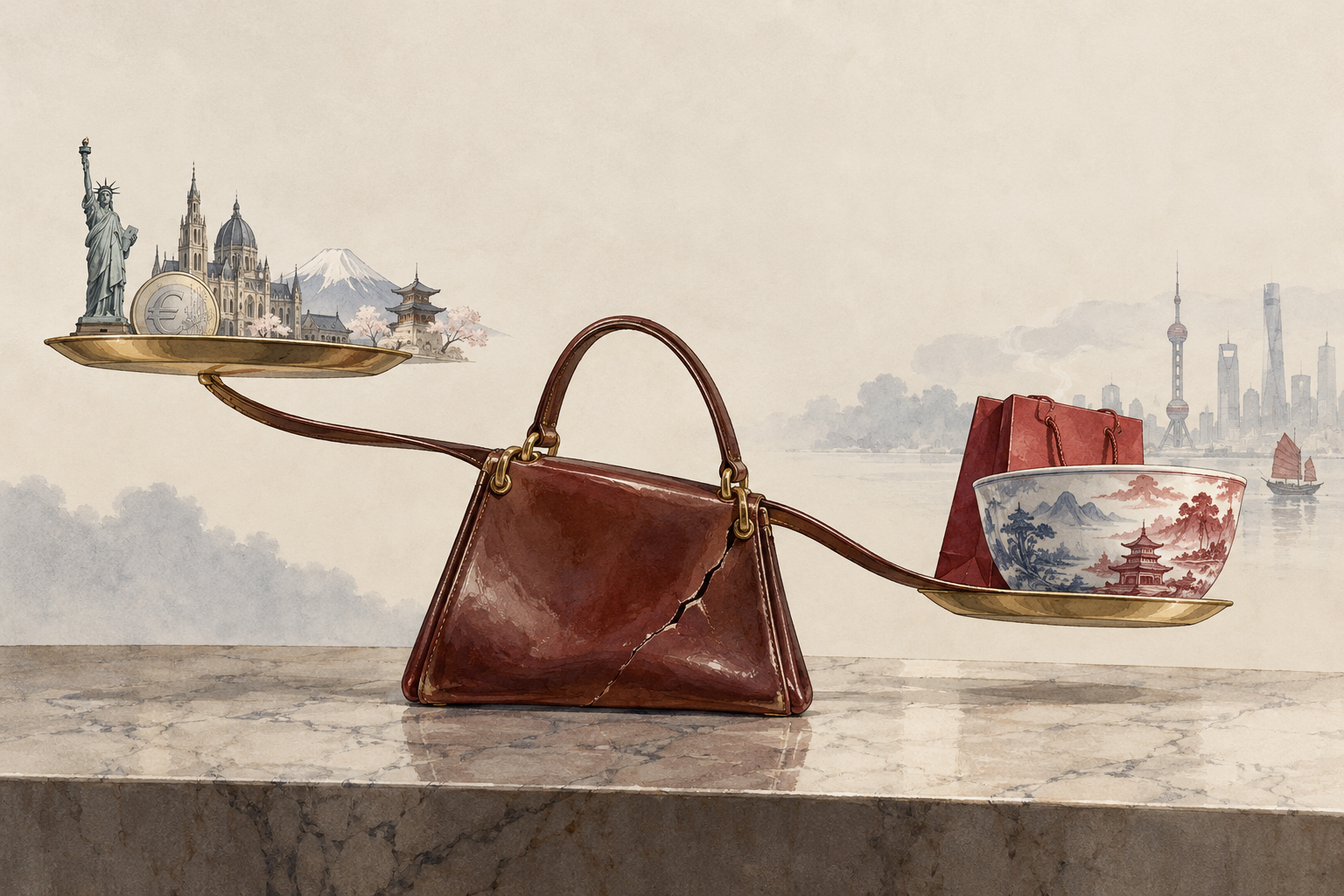
The geographic read-through was mixed. LVMH’s release emphasized resilience outside China, saying the US, Europe and Japan posted growth in the quarter.2 But Reuters’ expanded report said sales in Asia, a region dominated by China, fell 5% year on year, while US sales rose 5%.8
That implies the offset is real but incomplete. North American demand is helping, and Japan remains supportive, but China’s downturn is still strong enough to drag down the group’s most important division.
For investors, the question is not simply whether LVMH can grow. It is whether growth is returning in the right places. Fashion & Leather Goods generated €26.4 billion of revenue in the first nine months, equal to roughly 46% of group revenue, and is widely viewed as the center of LVMH’s margin strength.2 A 5% organic contraction in that division therefore carries more weight than growth in smaller or lower-margin lines.
The company said the division continued to benefit from a buoyant US market but was hit in the third quarter by slower demand in China.2 Reuters reported that Chief Financial Officer Cécile Cabanis told analysts Asian demand was pressured by a sharp deterioration in Chinese consumer sentiment, affecting discretionary spending.8
The market context raises the stakes. Reuters described LVMH as the world’s largest luxury group and the first major sector player to report third-quarter results. It added that the update was likely to unsettle investors in a $350 billion industry that has been in a three-year slowdown.7
In the broader Reuters follow-up, analysts at Bank of America said the results were likely to be a negative catalyst for the sector, while RBC’s Piral Dadhania expected modest pressure on LVMH and peer shares.8
The concern is that the luxury recovery narrative increasingly depends on a narrow set of offsets: US spending, Japanese tourism and local demand, and selective strength in Europe. Those supports can soften the impact of China. But LVMH’s third quarter suggests they may not be enough to re-accelerate the category if Chinese consumers remain cautious.
The issue is especially acute because luxury valuations have historically rewarded visibility, pricing power and high incremental margins. When the highest-margin division slows, investors tend to question not only sales growth but also operating leverage, marketing intensity and the sustainability of price increases.
Reuters noted that LVMH’s US-listed shares fell more than 3% after the update and that Europe’s leading luxury groups had already lost about €330 billion in market value since the start of the year.8
The report was not uniformly negative. Watches & Jewelry posted 6% organic growth in the third quarter and 8% growth for the first nine months, supported by brands including Tiffany and Bvlgari.2 Selective Retailing, which includes Sephora, grew 8% organically in the quarter and 6% over nine months.2 Wines & Spirits also improved, with 6% organic growth in the quarter.2
But mix matters. Strength in Sephora and jewelry helps stabilize group revenue, but it does not erase the signal from Fashion & Leather Goods, where Louis Vuitton and Dior sit at the center of the group’s brand equity and earnings quality.
LVMH said Louis Vuitton marked the 130th anniversary of the Monogram and highlighted momentum in ready-to-wear and menswear, while Dior benefited from Jonathan Anderson’s designs.2 Those brand-level initiatives may support desirability over time. For now, the numbers show weaker conversion in key Chinese demand pools.
The implications now shift to the rest of Europe’s luxury reporting season. Reuters said Hermès and Kering are due to publish third-quarter sales the following week.8
That creates a sharp read-across test. Hermès is typically seen as the sector’s most resilient compounder, while Kering is still exposed to questions around Gucci’s turnaround. If Hermès shows stronger insulation from China and Kering remains under pressure, investors may further separate perceived quality winners from recovery plays.
For LVMH, the third-quarter message is more nuanced than a simple disappointment. The group is still growing organically, and several divisions remain positive. But the latest numbers weaken the argument that US and Japan demand alone can carry the sector through a prolonged China slump.
Until Fashion & Leather Goods stabilizes, European luxury equities may struggle to sustain a broad rerating.

Bytes Technology’s half-year update gives UK mid-cap investors a cleaner read on corporate software, cloud and cybersecurity demand, but the key question is whether growth is being converted into higher-quality profit. AI is becoming a more meaningful demand driver, while higher technology costs and normalised bonuses are keeping operating leverage under scrutiny.

Japan’s September corporate goods prices cooled more than expected, but yen-based import prices still surged 24.5%, keeping cost-push pressure alive. For global macro investors, the signal is less disinflation than a narrower path for the Bank of Japan ahead of its late-October policy meeting.

Bellway’s full-year results point to resilience in cash generation but not yet a clean demand recovery. Its FY27 guidance implies lower completions, further margin pressure and continued reliance on bulk sales while mortgage affordability and build-cost inflation remain the sector’s dominant constraints.

Hays’ 14th consecutive quarterly net-fee decline suggests the UK and European hiring slowdown is showing up in listed recruiter revenues, not just official labour data. Michael Page’s next update will test whether the pressure is company-specific or sector-wide.
Organic revenue growth
Sales growth excluding currency movements and changes in the company’s structure, giving a cleaner view of underlying demand.
Fashion & Leather Goods
LVMH’s largest and most closely watched division, including Louis Vuitton, Dior, Celine, Fendi and other major brands.
Read-across
An investor term for using one company’s results to infer what may happen at similar companies in the same sector.
High-margin luxury
Luxury categories, especially handbags and leather goods, that typically generate stronger profitability than many other consumer products.
Comments