CPI, Bank Earnings to Test Wall Street’s Higher-Rate Rally
Associated Press
news
Inflation reports, retail sales and bank profits are among the key economic updates next week
The Economic Times / Reuters
news
Wall Street Week Ahead: Bank earnings, CPI headline busy markets week as S&P 500 hovers near records
Risk Premium Research Tools
data
Shiller Adjustments
CPI test
September CPI is expected to show 3.7% annual inflation, with core CPI at 2.5%, before the Fed’s October 27-28 meeting.
Bank kickoff
JPMorgan, Goldman Sachs, Citigroup and Wells Fargo report Tuesday, followed by Morgan Stanley and Bank of America on Wednesday.
Oil pressure
Oil has moved back above $100 a barrel, keeping energy costs central to the inflation and consumer-spending outlook.
US stocks enter the coming week with valuations still supported by an earnings narrative, not a rates narrative.
That distinction matters. The S&P 500 is hovering near records after a year-to-date gain of more than 14%, even as the benchmark 10-year Treasury yield sits around 5.24% and renewed oil volatility threatens to keep inflation pressure alive.3
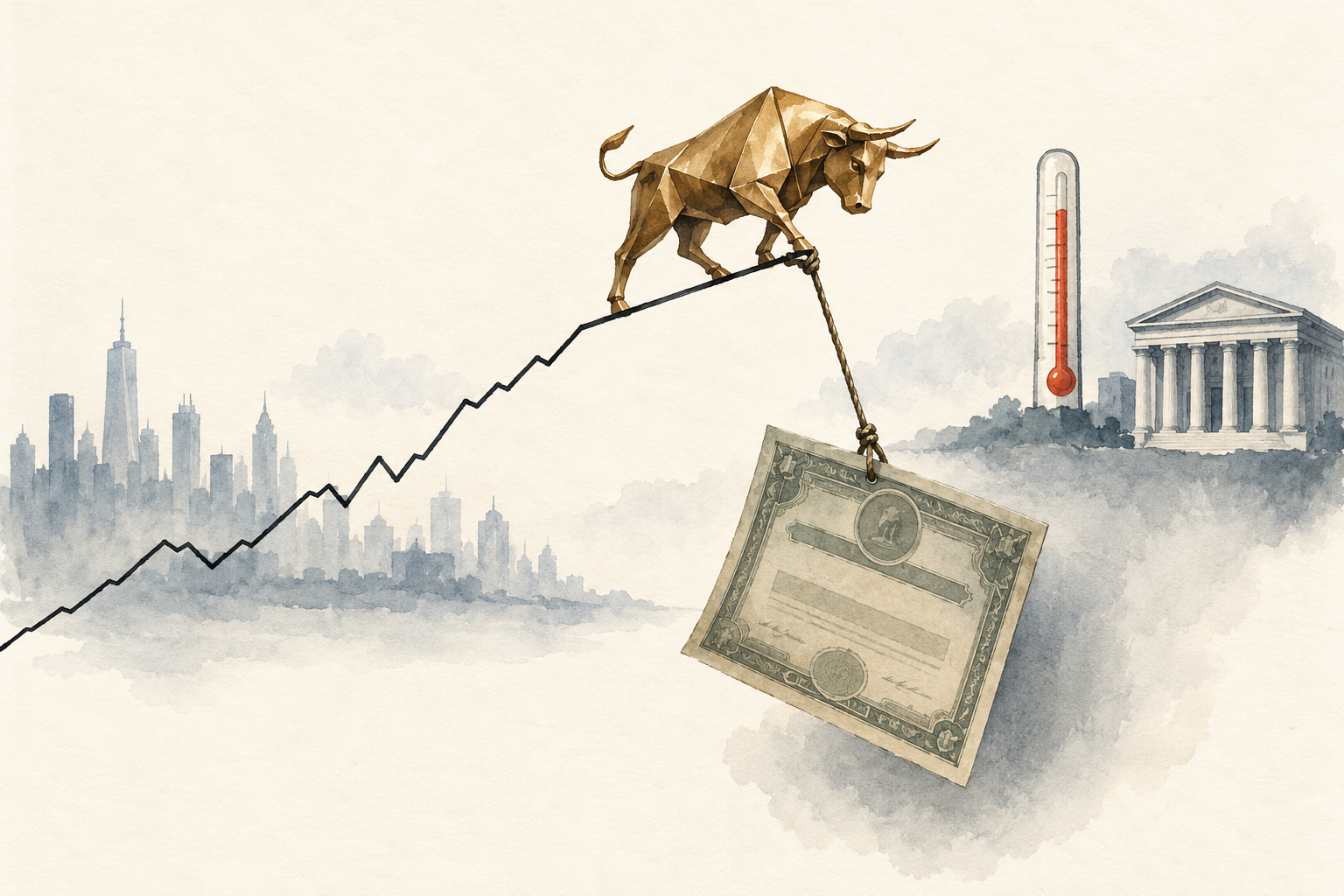
The market’s wager is straightforward: If September inflation is contained and the first major banks show that consumers, credit and capital markets remain resilient, investors can argue that profit growth is strong enough to justify elevated equity prices.
If CPI surprises higher, or if bank executives point to weaker borrowers, higher funding costs or softer loan demand, those valuations become harder to defend before the Federal Reserve’s October 27-28 policy meeting.3
The rally has so far treated earnings as a cushion against higher rates. Reuters reported that S&P 500 earnings are expected to have risen by more than 30% in the third quarter, according to LSEG IBES, following a strong first half.3
That scale of profit growth is the central bullish argument. Companies are not merely surviving tighter financial conditions; many are still expanding margins and earnings power.
But the hurdle rate has also moved higher. A 10-year Treasury yield above 5% gives global investors a credible alternative to equities and raises the discount rate applied to future corporate cash flows.3
In practical terms, high-growth stocks need stronger future earnings to justify the same price, while cyclical companies need to show that nominal demand is not being consumed by borrowing costs and input inflation.
That is why next week’s calendar carries unusual weight. September CPI is due Wednesday, October 14, followed by producer-price and retail-sales data. JPMorgan Chase, Goldman Sachs, Citigroup and Wells Fargo report Tuesday, while Morgan Stanley and Bank of America follow Wednesday.3
The sequencing matters. Investors will be judging bank balance sheets and consumer conditions almost simultaneously with the inflation data that will shape expectations for the Fed’s next move.
Economists in a Reuters poll expect September CPI to show a 3.7% annual increase, with core CPI, which excludes food and energy, rising 2.5%.3
That would still leave inflation above the Fed’s 2% target. But the market reaction will depend less on the headline number than on the composition.
A benign report would show limited pass-through from higher energy prices and continued moderation in services inflation. That would support the view that the Fed can avoid a more aggressive tightening cycle after raising rates last month for the first time since 2023.3
It would also help equities by stabilizing the bond market. Lower or steadier yields would make earnings multiples less vulnerable.
A hotter report would have the opposite effect. AP reported that renewed violence has pushed oil back above $100 a barrel, with average US gasoline prices still well above $4 a gallon and diesel near September’s record highs.2
Energy is volatile, but it matters. Persistent fuel costs can lift inflation expectations, squeeze household budgets and pressure transport-sensitive margins.
For equity valuations, the key risk is not one month of expensive oil. It is the possibility that energy, wages and services costs reinforce one another when policy rates are already restrictive.
If investors conclude inflation is reaccelerating, the earnings buffer may not be enough to offset another move higher in yields.
The first bank reports will test the other side of the market’s thesis: whether nominal growth and corporate activity remain strong enough to sustain earnings.
Banks offer a broad read on the economy because they touch consumers, businesses, trading desks, investment banking pipelines and credit quality.
Analysts expect large profit gains at some lenders, including a projected 47% increase at JPMorgan Chase and a 61% increase at Citigroup, according to AP.2
Strong headline profits would help validate the market’s confidence, especially if they come with healthy net interest income, resilient card spending and signs of improving capital-markets revenue.
Still, the commentary may matter more than the numbers. Investors will be listening for changes in credit-card delinquencies, commercial real-estate exposure, loan-loss provisions and management comments on household cash flow.
Reuters noted that bank stocks have recently lagged, with the S&P 500 banks index down 7.5% over the past month as Treasury yields rose.3 That underperformance suggests the market is already alert to the risk that higher rates are not uniformly positive for lenders.
Higher rates can support bank margins, but only up to a point. If deposit costs rise, loan demand slows or credit losses increase, that benefit can fade quickly.
For global investors, the banks’ message on the US consumer will also inform views on exporters, commodity demand and the dollar, because US household spending remains a major driver of global growth.
Retail sales are the bridge between CPI and earnings. If sales remain firm, investors can argue that consumers are still absorbing higher prices and that corporate revenue growth has room to continue.
If spending softens, especially in discretionary categories, the market will have to reconsider whether nominal revenue growth is masking pressure on real demand.
AP’s week-ahead preview places retail sales alongside CPI, producer prices and bank earnings as one of the major updates for the US economy.2
Together, those data will help answer a crucial question: Are higher prices still being passed through, or are households beginning to trade down, delay purchases and rely more heavily on credit?
The answer matters for margins. Companies can tolerate inflation when they have pricing power. They struggle when input costs rise but customers resist higher prices.
Banks, retailers and consumer-facing companies should therefore be read together rather than in isolation.
The broader valuation backdrop makes the week more consequential. Shiller-based valuation measures, including tax-adjusted versions scaled to current S&P 500 levels, continue to point to rich market pricing by long-run standards.11
At the same time, S&P 500 earnings-growth data show why investors have been willing to pay up: Profit momentum has been a real support for the index, not merely a story about multiple expansion.12
That combination creates a narrow path. Strong earnings can justify high valuations if inflation falls, yields stabilize and banks confirm that credit stress is contained.
But when the risk-free rate is above 5%, the burden of proof shifts. Equities need either faster earnings growth, lower yields or both.
The market’s recent resilience suggests investors are not yet ready to abandon the profit-growth thesis. The S&P 500’s ability to hold near records despite higher yields shows that earnings expectations are still dominating macro anxiety.3
But that resilience is conditional, not guaranteed.
The bullish scenario is clear: CPI lands near or below expectations, core services inflation cools, producer prices do not show a broadening pipeline of cost pressure, and retail sales show steady but not overheated demand.
Banks would then report strong profits with manageable credit costs and constructive commentary on consumers and capital markets.
In that outcome, investors could argue that the Fed has room to pause at its October 27-28 meeting, or at least avoid signaling a more forceful hiking path.3 Treasury yields could stabilize, and the market could continue to treat earnings growth as the dominant force.
The bearish scenario is equally clear. CPI comes in hot, oil-related costs appear to be spreading, retail sales suggest consumers are leaning on credit rather than income, and banks raise provisions or warn about weakening loan quality.
In that case, the market would face a tougher combination: higher inflation, higher rates and less confidence in future earnings.
For now, Wall Street is not pricing a collapse in profits. It is pricing the belief that earnings strength can buy time until inflation cools.
Next week will test whether that belief is analysis or complacency.

U.S. ocean container imports reached a September record, with China-origin shipments up 21.2%, underscoring resilient consumer demand and retailer restocking. The same surge complicates the macro picture by raising questions about inventory buildup, tariff timing and whether goods-price disinflation can keep helping inflation ahead of CPI.

France’s 2027 budget has not stopped investors from demanding a larger premium for holding OATs, raising the question of whether Paris is still priced as a core euro-area borrower. The repricing is feeding into the euro, narrowing the traditional gap between French and Italian debt risk, and complicating the European Central Bank’s room to keep tightening.

Thirty-year gilt yields near 6% are signaling that investors are charging the UK a credibility premium ahead of the 28 October Budget. A November Bank of England hike may support sterling, but it may not be enough to cap long-end yields if fiscal plans fail to reassure markets.

JPMorgan, Goldman Sachs, Citigroup and Wells Fargo report before the open on Tuesday, October 13, giving investors the first major read on whether rising Treasury yields are lifting bank income or starting to hurt loan demand, market activity and valuations.
CPI
The Consumer Price Index measures changes in prices paid by consumers and is one of the main inflation indicators watched by the Federal Reserve.
Core CPI
A version of CPI that excludes food and energy, which are often volatile, to give a clearer view of underlying inflation trends.
10-year Treasury yield
The interest rate on US government debt maturing in 10 years; it is a key benchmark for mortgages, corporate borrowing and equity valuations.
Shiller CAPE
A valuation measure that compares stock prices with inflation-adjusted average earnings over a long period, often used to judge whether the market is expensive by historical standards.
Comments