China’s factory-gate rebound points to margin squeeze before inflation pass-through
Associated Press
news
China’s carmakers export more as EU caps hybrid vehicle imports at 350,000 a year
State Taxation Administration of China / Xinhua
government
China to cut NEV export tax rebate for high-quality auto industry growth
National Bureau of Statistics of China
government
2026年9月份居民消费价格同比上涨0.9%
PPI jumps
China’s producer prices rose 5.0% year on year in September, the fastest pace since June 2022.
CPI lags
Consumer inflation rose only 0.9%, with food prices down 1.7% and core CPI at 1.0%.
Input squeeze
Fuel and power costs rose 13.6%, chemical raw materials 12.6%, and non-ferrous metals and electrical wire 20.0%.
China’s September inflation data point to a shift in the global goods-pricing cycle: the country is no longer exporting outright deflation, but it may not be exporting much inflation yet. Producer prices rose 5.0% year on year, the fastest pace since June 2022, while consumer prices increased just 0.9% and missed forecasts, Reuters reported.6
The gap matters for global markets. It suggests the first impact of higher oil, chemicals and metals costs is likely to land in corporate margins, not immediately in factory-floor or checkout prices.
National Bureau of Statistics data show where the pressure is building. China’s producer price index rose 5.0% in September, while industrial purchasing prices climbed 6.9%. Fuel and power costs rose 13.6%, chemical raw materials were up 12.6%, and non-ferrous metals and electrical wire prices jumped 20.0%.4
Officials attributed much of the PPI acceleration to higher international crude oil and non-ferrous metals prices, with gains in petroleum extraction, refined oil, organic chemical raw materials and metals.5
The consumer side remains weak. China’s CPI rose 0.9% year on year in September, with food prices down 1.7% and core CPI, excluding food and energy, up 1.0%.3 Market expectations had been for CPI to rise 1.0%, while PPI came in above consensus, according to market-facing data reports.7
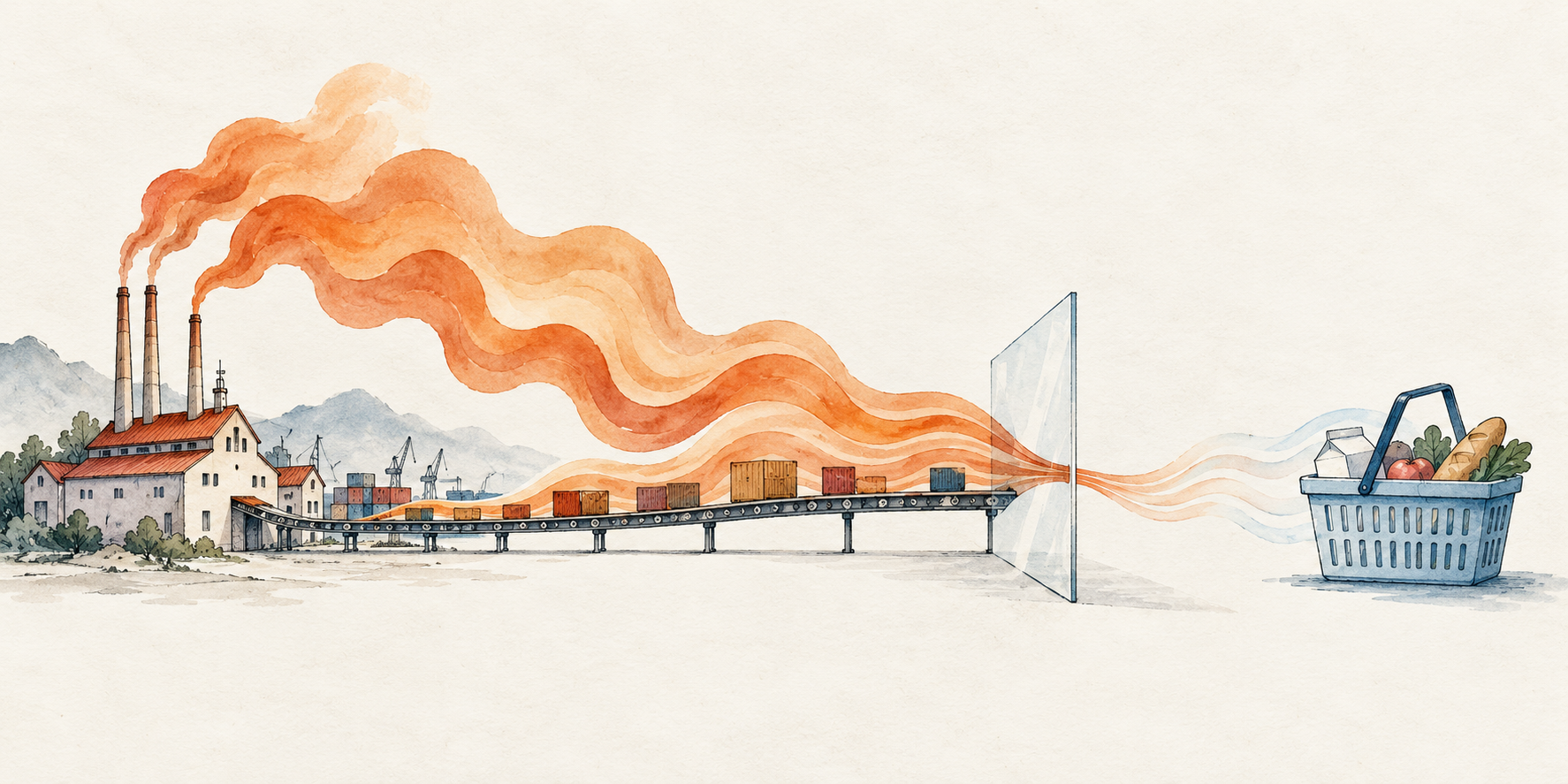
That combination — stronger factory-gate inflation and soft household inflation — is the classic signature of a margin squeeze.
The September data do not show a broad consumer-inflation problem. They show a cost problem.
For Chinese manufacturers, the input basket is becoming more expensive just as domestic demand remains too weak to absorb higher end-prices. In sectors tied to energy, chemicals, electrical equipment, autos and metals-intensive production, the question is not whether costs are rising. It is who pays.
For now, the answer may be producers, exporters and overseas distributors. If Chinese factories cannot lift prices at home, they may try to recover costs through export markets. But strong global competition, trade restrictions and bargain-seeking consumers in Europe and elsewhere limit that option.
The result is a more complicated version of the post-pandemic goods cycle: not deflation, but not clean pass-through either.
This matters for UK and global investors because China sits deep inside the world’s manufactured-goods supply chain. Higher Chinese PPI can feed into import costs for machinery, electronics, vehicles, industrial components, packaging and consumer durables.
But if Chinese exporters absorb the shock, the effect shows up first in earnings, credit quality and trade margins rather than in headline consumer inflation abroad.
China’s domestic price data underscore the demand constraint. Food prices fell in September, led by declines in pork and fresh vegetables, while services inflation was modest.3 The NBS release also showed small-car prices down 1.7% year on year, a reminder that competitive pressure remains visible even in high-profile manufacturing sectors.3
That weak household backdrop makes broad pass-through harder. Manufacturers facing higher oil-derived and metals costs can raise prices only if final demand is strong enough to tolerate it. China’s CPI miss suggests it is not.
The implication is that the domestic economy may act as a brake on global goods inflation even as upstream costs rise.
Reuters framed the issue similarly, noting that factory-gate inflation had heated up as commodity costs rose while CPI lagged forecasts.6 AFP also reported that producer prices jumped 5.0%, linking the divergence with subdued consumer inflation and pressure from oil prices and supply conditions.8
China’s external sector is still doing much of the heavy lifting. September exports surged 36.3% from a year earlier, imports rose 31%, and the monthly trade surplus reached $133.5 billion, according to AP.9 Reuters separately reported that robust overseas demand was offsetting weak consumer spending and subdued domestic demand.10
That export strength gives manufacturers volume, but not necessarily pricing power. When domestic demand is soft, exporters have an incentive to defend overseas market share, even if that means accepting narrower margins.
In other words, China may export more goods at prices that do not fully reflect the increase in its input costs.
Autos provide a useful sector example. AP reported that China’s passenger-car exports rose 64% in September while domestic passenger-car sales fell 27%, illustrating how manufacturers are leaning harder on foreign markets as home demand falters.1 Shanghai Metals Market described the auto market as “cold at home, hot abroad,” while also noting crude-oil strength and mixed metals trading around the same period.12
The pricing pressure is not limited to raw materials. Beijing’s decision to cut the export tax rebate for new-energy vehicles to 9% from 13% will add another cost headwind for automakers.2 Caixin reported that the change is expected to raise export costs and could potentially lift overseas prices.11
Whether automakers can pass those costs on will depend on competition, tariffs, local subsidies and the strength of demand in Europe and other export markets.
For much of the recent cycle, China helped dampen global goods inflation by exporting cheaper manufactured products. September’s PPI data suggest that phase is fading. A 5.0% factory-gate increase is not compatible with a simple deflation-export story, particularly when purchasing prices are rising even faster.4
Still, the data do not point to a sudden consumer-price shock. The more likely near-term outcome is uneven pass-through. Commodity-linked producers may push for price increases; downstream manufacturers may resist; exporters may absorb some costs; overseas retailers may delay price changes; and consumers may see only selective increases in goods categories with tight supply or strong brands.
For markets, the signal is more important than the headline. If higher Chinese PPI persists, analysts will watch gross margins at exporters, European retailers, industrial distributors and companies dependent on China-sourced components.
A delayed pass-through could also complicate central-bank narratives: goods disinflation may stop helping, even if it does not immediately turn into a new inflation wave.
One month of stronger PPI does not prove a lasting global cost cycle. The September jump was heavily influenced by oil and metals, both volatile. If commodity prices retreat, the margin squeeze could ease before it reaches consumers.
But if crude, chemicals and non-ferrous metals remain elevated, China’s manufacturers will face a choice: raise prices, cut margins, or push for more volume abroad.
The September split between 5.0% PPI and 0.9% CPI suggests the burden is currently falling closer to producers than households.34 That is manageable for a short period, especially for large exporters with scale. It becomes more problematic if combined with tax-rebate cuts, trade barriers, currency volatility or weaker overseas demand.
China is therefore moving from a deflationary export force to a potential margin-pressure transmitter. The inflation may not yet be visible in consumer baskets in London, Frankfurt or New York. But it is increasingly visible in the cost base of the factories that supply them.

Whitbread’s first-half results show Premier Inn still gaining accommodation revenue in the UK and Germany, but the investment case now depends on whether that growth can compound faster than cost inflation, impairments and activist pressure. Corvex’s board-seat campaign turns the hotel group into a live test of how much patience investors still have for UK consumer-sector self-help plans.

BP’s third-quarter update put a sharp refining-margin uplift and faster deleveraging ahead of another multibillion-dollar impairment charge tied mainly to transition businesses. The share-price reaction suggests investors are prioritising near-term cash generation, but the reset leaves capital-discipline questions unresolved.

ASML’s record Q3 results validate the artificial-intelligence capital-spending cycle, but they also expose the next constraint: whether Europe’s most important semiconductor-equipment supplier can expand lithography capacity fast enough through 2028. For investors, the question is moving from whether AI demand is real to whether supply, export controls and order timing can sustain ASML’s valuation.

Bytes Technology’s half-year update gives UK mid-cap investors a cleaner read on corporate software, cloud and cybersecurity demand, but the key question is whether growth is being converted into higher-quality profit. AI is becoming a more meaningful demand driver, while higher technology costs and normalised bonuses are keeping operating leverage under scrutiny.
Producer Price Index
PPI measures prices received by producers at the factory gate. It often captures input-cost pressure before it reaches consumers.
Consumer Price Index
CPI tracks prices paid by households for goods and services. Weak CPI can signal limited consumer demand or poor pricing power.
Pass-through
Pass-through is the process by which higher input costs are passed on to final buyers through higher prices.
Export tax rebate
A rebate refunds part of the value-added tax paid by exporters. Cutting it raises effective export costs unless companies lift prices or absorb the hit.
Comments